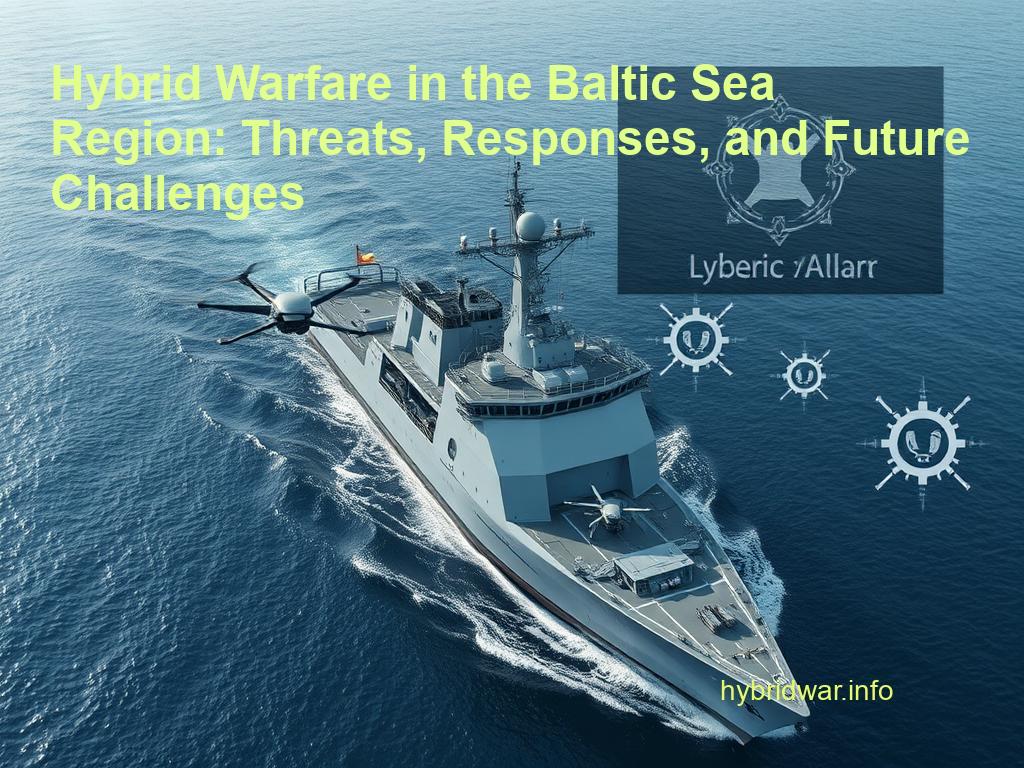
Hybrid Warfare in the Baltic Sea Region: Threats, Responses, and Future Challenges
Introduction: The Strategic Significance of the Baltic Sea Region
The Baltic Sea region holds an unparalleled strategic importance in European security architecture. Not only is it a vital corridor for energy transit, trade, and military maneuvering, but its unique geographic position also renders it a hotspot for the geopolitical tug-of-war between regional and global powers. The area’s complex history, marked by shifting alliances and contested sovereignties, makes it an ideal theater for hybrid operations. Since the Cold War, and even more so in recent decades, the Baltic Sea has witnessed an increased deployment of multipronged threats that blend traditional military tactics with unconventional methods. This blog post delves into these dynamics, illustrating how the security of the Baltic Sea is critical not only for regional stability but also as a linchpin in the broader European and global security landscape.
Understanding Hybrid Warfare: Definitions and Tactics
Hybrid warfare represents a convergence of conventional military tactics with nontraditional methods including cyberattacks, disinformation campaigns, sabotage, and covert intelligence operations. This evolving approach allows state and non-state actors to undermine an adversary’s capabilities without engaging in full-scale open conflict. In the contemporary security arena, such tactics are deliberately ambiguous, making attribution difficult and response measures complex. The definition of hybrid warfare, therefore, extends beyond the military domain into the realms of politics, economics, and social stability. This integrated form of conflict aims to disrupt decision-making and erode public trust in state institutions. Scholars and policymakers alike are increasingly focusing on hybrid warfare as a paradigm that challenges existing defensive frameworks. The tactics observed in the Baltic Sea region serve as a microcosm of this broader strategic philosophy.
Russia’s Hybrid Operations in the Baltic: Cyberattacks and Disinformation
Russia has been at the forefront of deploying hybrid methods in an attempt to destabilize the Baltic region. One of the primary tools in its arsenal is cyber warfare. Russian intelligence services have orchestrated a series of sophisticated cyber-espionage and cyber disruption campaigns targeting critical government networks, energy infrastructures, and key sectors such as healthcare in the Baltic states. An infamous example of these cyber operations is reflected in the activities of the so-called “Doppelgänger” network, which has been engineered to produce counterfeit news outlets aimed at spreading pro-Kremlin propaganda. These disinformation campaigns not only seek to polarize societies but also aim at eroding public trust in democratic institutions. More on these tactics can be read in depth at Wikipedia’s detailed account of Russian hybrid warfare in Europe (https://en.wikipedia.org/wiki/Russian_hybrid_warfare_in_Europe_%282022%E2%80%93present%29?utm_source=openai).
Sabotage of Critical Infrastructure: Undersea Cables and Maritime Security
In addition to cyber operations, sabotage of physical infrastructure is a critical element of hybrid warfare in this region. The sabotage incidents along critical undersea assets provide stark evidence of how multifaceted these operations are. The explosion incidents in 2022, which ruptured the Nord Stream 1 and 2 gas pipelines, are a prominent illustration of this approach. Reports have suggested that these attacks were executed by elements operating from what some analysts refer to as Russia’s “shadow fleet”—a network capable of circumventing Western sanctions through ambiguous ownership structures. More recently, in 2023, the Balticconnector gas pipeline and telecom cables linking Estonia with Finland and Sweden were compromised following an incident involving a Chinese vessel. Investigations indicated that Russian intelligence might have influenced the vessel’s captain to inadvertently trigger the sabotage by dragging its anchor along the Baltic seabed. These events underscore the sophisticated nature of hybrid tactics that combine stealth, misdirection, and international proxies. For further insights, refer to the American University report on securing critical infrastructure (https://www.american.edu/sis/centers/transatlantic-policy/articles/20250424-securing-the-depths.cfm?utm_source=openai).
NATO’s Response: The Baltic Sentry Mission and Regional Security Enhancements
Confronted with an array of hybrid threats, NATO has rapidly evolved its strategic posture in the Baltic Sea region. A pivotal component of its response strategy has been the launch of the Baltic Sentry Mission in January 2025. This operation is designed to protect critical undersea infrastructure by deploying a diverse array of assets, including frigates, maritime patrol aircraft, and naval drones, in addition to integrating national surveillance systems. Complementing this, NATO established the Critical Undersea Infrastructure Coordination Cell in February 2023 to foster cooperation among its Allies, partners, and private sector stakeholders. Furthermore, the establishment of the Maritime Centre for the Security of Critical Undersea Infrastructure in May 2024 underscores the alliance’s commitment to preempting sabotage activities. Detailed information on these initiatives can be found on NATO’s official website (https://www.nato.int/cps/en/natohq/70759.htm?utm_source=openai). These robust measures reflect NATO’s evolving doctrine, which addresses the hybrid nature of modern threats by reinforcing multi-layered defense mechanisms.
Intelligence Gathering and Countermeasures in the Baltic States
Effective response to hybrid warfare demands timely and accurate intelligence. In the Baltic states, efforts to bolster cyber intelligence and physical security measures have been significantly enhanced in recent years. Counter-intelligence units are now collaborating more closely with international partners to share critical information about potential threats, particularly those arising from sophisticated cyber intrusions. The evolution of intelligence operations in this region mirrors the changing nature of warfare where cross-border cooperation plays a key role. Governments have invested in both human intelligence and technological solutions, such as advanced surveillance systems and AI-based threat detection platforms, to monitor potential breaches and unusual maritime activities. These efforts are instrumental in mitigating the risks posed by both overt sabotage and covert operations orchestrated by hybrid adversaries.
Emerging Content Gaps: Civil Society, Effectiveness of Countermeasures, and Non-State Actors
While state actors have received considerable attention, hybrid warfare also exposes significant vulnerabilities in civil society. Recently, emerging research highlights a gap in understanding the profound impact that the spread of disinformation has on social cohesion. Grassroots organizations, including groups such as Propastop, the Czech Elves, and the Baltic Elves, are playing an essential role in combating false narratives and countering disinformation campaigns. These non-state actors leverage advanced technologies to monitor social media, analyze the propagation of fake news, and swiftly alert the public to unverified information. Moreover, platforms like NorthSeal, operational since January 2025, are pioneering efforts to track suspicious maritime activity and coordinate rapid responses among North Sea nations. Although NorthSeal is primarily focused on the North Sea, its framework provides valuable insights into how similar collaborative strategies could enhance security in the Baltic Sea (https://en.wikipedia.org/wiki/NorthSeal?utm_source=openai). This emerging convergence of state and non-state efforts marks a critical frontier for research and operational improvement in hybrid defense tactics.
Future Challenges and the Long-Term Impact on European and Global Security
Looking ahead, the challenges posed by hybrid warfare are set to intensify as technology evolves and geopolitical rivalries become more entrenched. Future threats are likely to exploit new domains, leveraging artificial intelligence, quantum computing, and next-generation cyber tools. The Baltic Sea region, with its concentration of critical infrastructure and strategic maritime routes, will remain a focal point for potential disruptions. As hybrid adversaries refine their tactics, European security actors must invest in adaptive and resilient response strategies. Building a comprehensive counter-hybrid warfare framework will require continuous innovation, robust international collaboration, and an integrated approach that melds cyber, physical, and intelligence operations. The unfolding nature of these future challenges necessitates that policymakers craft long-term strategies that not only address immediate risks but also anticipate and mitigate emerging vulnerabilities.
Conclusion: Strengthening Resilience Against Hybrid Threats in the Baltic Sea
In the face of a rapidly evolving hybrid threat landscape, resilience is paramount. The multifaceted nature of hybrid warfare, characterized by a blend of cyberattacks, disinformation, infrastructure sabotage, and intelligence operations, mandates a coordinated and comprehensive response. The Baltic Sea region, due to its inherent strategic significance, will continue to be a battleground for these unconventional conflicts. By drawing on a combination of state-of-the-art defense technologies, enhanced intelligence gathering, and proactive measures by NATO and regional organizations, stakeholders can fortify the region against future threats. The ongoing collaboration between governmental actors, international alliances, and civil society groups serves as a robust foundation, but much remains to be done. Sustained, adaptive, and forward-thinking strategies will be essential to secure the safety and stability of the Baltic Sea and, by extension, contribute to a wiser, more secure global environment.